Loading drawings…
Life Drawing, Critical Inquiry and Artificial (Visual) Intelligence
The Life Drawing Controversy
Life drawing provokes strong reactions. Artists seem to either love it or hate it.
I once told a colleague at the Glasgow School of Art that I thought life drawing was the jewel in the crown of art education. He dismissed the idea angrily and hardly spoke to me after that. Why does something as apparently innocuous as life drawing generate so much hostility?
The following notes begin to explain my commitment to life drawing and the academic model.
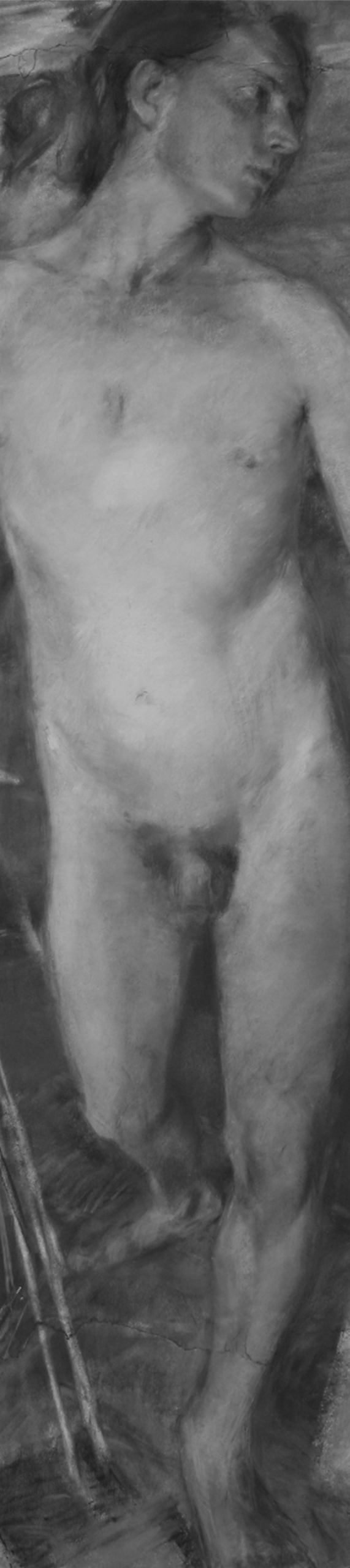
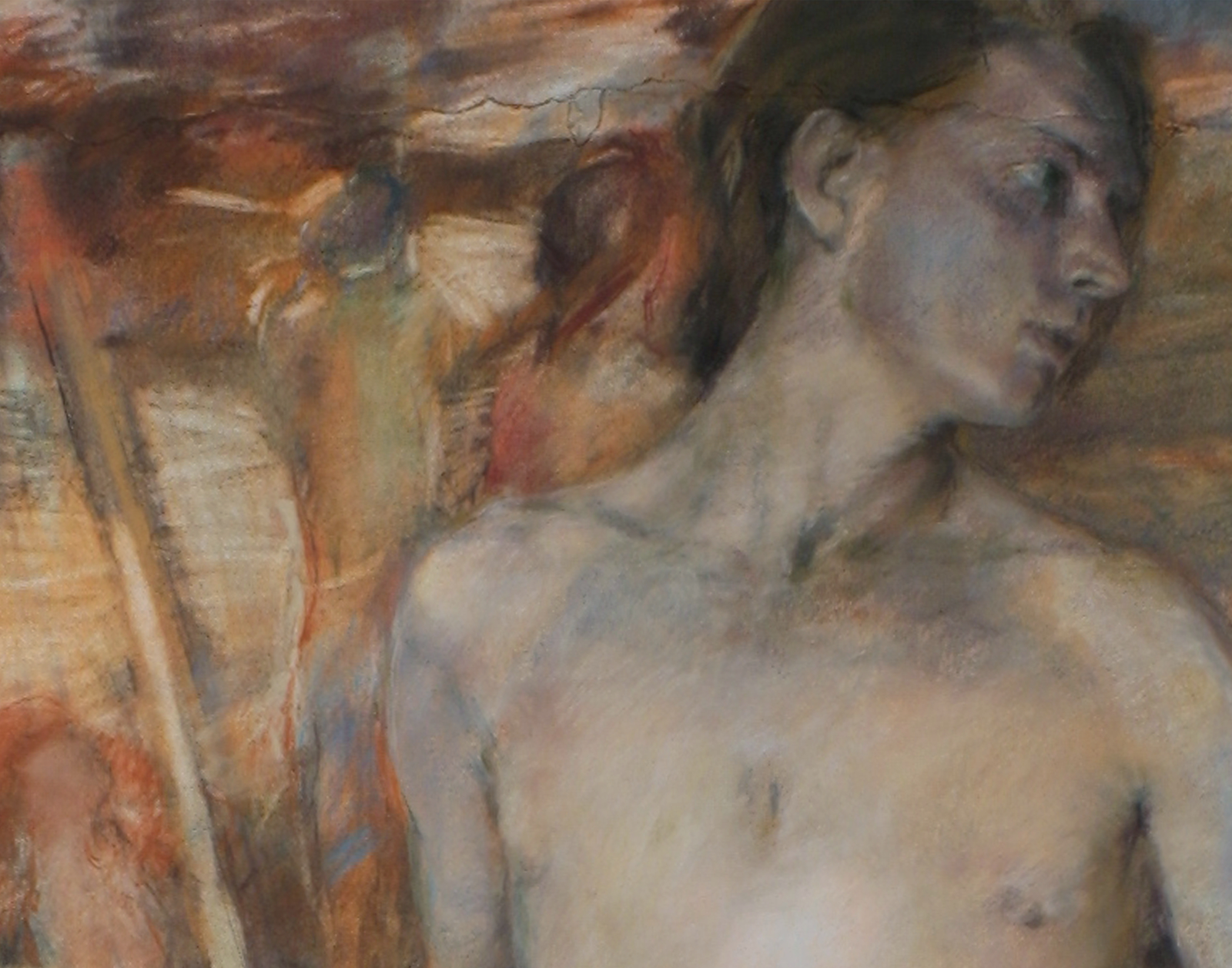
Most of the drawings on display were made at the Glasgow School of Art between 1990 and 2003.
Introduction
Vision is our primary sense. The mechanics of the human eye have remained largely unchanged in recent evolutionary history. Our hunter/gatherer ancestors needed well-developed observational skills to survive in a dangerous environment. In our own times, the visual and cultural industries thrive in a competitive marketplace and rely on a steady stream of visually sophisticated practitioners. The new challenges posed by Artificial Intelligence will inevitably demand even higher levels of skilled professional practice, including the visual skills that produced our culture in the first place and may even help to preserve our humanity in the dangerous world of AI.
Life Drawing and Objective Inquiry
Artists draw from the life figure to improve their powers of observation, knowledge of human anatomy and to understand the traditions contributing to our shared visual culture.
Often described as “eye training”, the academic method developed over more than three centuries in art academies across Europe and America. Founded on the working practices of artists and artisans of the Classical world, academic drawing is characterised by visual objectivity and sight-size measurement from a single viewpoint. It is strictly evidence-based.
In the life room, the model is often posed unclothed or with simple drapery acknowledging life drawing’s ancient origins. The enduring skills practiced in the life room have given us many of the greatest achievements of European art. The formal representation of the naked human figure, the nude, for instance, is one of the inventions of European visual culture that defines us but contrasts sharply with other Mediterranean cultures whose religious beliefs prohibit representations of the human figure: Judaism and Islam.
The human body is one of the most thoroughly studied subjects in both art and science. It is uniquely familiar to us. We know what it feels like to inhabit a human body. The sensations of muscular tension, relaxation and compression are routine to us, and we know what a ribcage and a pelvis feel like both inside and out. Our knowledge of our own anatomy, and therefore of the anatomy of others, including the life model, is intimate and instinctive. Despite centuries of sustained examination, the human figure remains one of the most profound, immediate and challenging objects of study for artists and scientists.
Academic art and the principal artistic movement of the twentieth century, Modernism, are very different but deeply connected traditions. Although Modernism is often defined by its rejection of academic conventions, it developed through an ongoing dialogue with them. For example, Pablo Picasso, one of the modern movement’s most celebrated artists, had a traditional academic training that gave him the skills and sources of inspiration fundamental to his revolutionary ideas.
These academic drawings are displayed not as anachronistic curiosities, but to encourage artists, designers and architects to strengthen their visual and perceptual skills and to explore the creative opportunities those skills provide.
Above all, a trained eye is valuable to anyone, even for its own sake. There can be immense pleasure in simply looking at the world.
Barry Atherton
11Oct26
Academic drawing and Modernism represent two very contrasting yet deeply interconnected pillars of art history. While Modernism is often defined by its rejection of academic traditions, it has developed through an ongoing dialogue with them. One of the modern movement’s most unconventional artists, Pablo Picasso, had an academic art training that was an important source of the skills and inspiration fundamental to his revolutionary ideas.
This collection of academic life drawings was made at the Glasgow School of Art between 1990 and 2003 as part of a broader course in observational studies. They are objective, sight-size drawings of the human figure seen from a single viewpoint.
Artists draw from the life figure to develop their skills of observation, visual analysis and knowledge of human anatomy, but also to gain a deeper understanding of art history, aesthetic theory and the wider traditions of European culture.
Vision is our primary sense. The mechanics of the human eye have not changed in recent evolutionary times. Observational acuity and refinement were vital skills for our hunter-gatherer ancestors’ survival. In our own times, the visual and cultural industries rely on a steady stream of visually skilled practitioners. The new Artificial Visual Intelligence systems will inevitably demand higher levels of skilled professional practice, including the observational skills that produced our culture in the first place, and may even help to preserve our humanity in the future.
The academic method is a traditional way of teaching and learning the skills of observation, often called eye training. It developed over more than three centuries in the art academies of Europe and America.
In the life room, the model is often posed unclothed or with simple drapery in recognition of life drawing’s ancient origins. The enduring skills practiced in the life room have given us many of the greatest achievements of European art. The formal representation of the naked human figure, the nude, for instance, is one of the inventions of European visual culture that defines us yet sharply contrasts with the treatment of the human figure in other Mediterranean cultures: Judaism and Islam.
The human body is the most studied and understood subject in art and science. It is uniquely familiar to us. We know what it feels like to inhabit a human body. We know what it feels like when muscles are under tension, relaxation, or compression; we know what a ribcage or a pelvis feels like inside and out. Our knowledge of our own anatomy, and by implication of others’, including the life model’s anatomy, is intimate and instinctive. The human figure, after centuries of intense examination, is still the most profound, immediate and demanding object of study for artists and scientists.
These academic life drawings are displayed not as anachronistic curiosities, but to highlight the value of critical in-depth objective visual inquiry and its wider application in contemporary art and art education.
After all said and done, a trained eye is a wonderful thing to have, even for its own sake; one can take the greatest pleasure in simply looking at the world.
Barry Atherton 25/9/26
Contact